A Postpartum Scalp Care Routine That Adapts
Build a postpartum scalp care routine that supports comfort, gentle cleansing, and healthy-looking regrowth through recovery and beyond with a measured approach.
HAAR Editorial
The HAAR editorial team — collective voice of our scalp longevity research.

Hair on the shower floor can make the postpartum period feel more alarming than it is. For many new mothers, shedding becomes noticeable several months after birth, often alongside a scalp that feels oilier, drier, itchier, or simply unfamiliar. A postpartum scalp care routine should not treat these changes as a cosmetic inconvenience. It should respond to a scalp moving through a real biological transition.
The goal is not to force growth overnight. It is to preserve scalp comfort, reduce avoidable stress on fragile strands, and create the conditions for healthy-looking regrowth as your system recalibrates.
Why the postpartum scalp changes
During pregnancy, higher estrogen levels keep more hairs in their active growth phase for longer. After delivery, those hormone levels shift. Hairs that were temporarily retained can move into their resting and shedding phase around the same time. This is commonly known as postpartum shedding, or telogen effluvium.
It can look dramatic because the change is concentrated. You may notice more hair around the hairline, part, temples, and shower drain. Yet the scalp is not a passive backdrop to this process. Sleep disruption, emotional stress, heat, humidity, frequent tying of the hair, nutritional demands, and changes in wash frequency can all influence how comfortable and balanced it feels.
This is why a generic hair routine can miss the point. A heavier oil may feel comforting on a dry scalp but leave an oily, congested scalp less comfortable. Aggressive exfoliation may seem proactive yet create irritation in a scalp already feeling reactive. Postpartum care needs observation before intensity.
The postpartum scalp care routine: start with regulation
Think in terms of regulation, not correction. Your scalp has changing needs, and the most useful routine is one you can maintain through interrupted sleep and limited time.
Cleanse for your current scalp condition
Wash according to your scalp, not a rule inherited from pregnancy or pre-pregnancy life. If oil, sweat, product residue, or flakes are building up, cleansing more regularly may support comfort. If your scalp feels dry, tight, or sensitive, use a gentle cleanser and avoid very hot water or prolonged scrubbing.
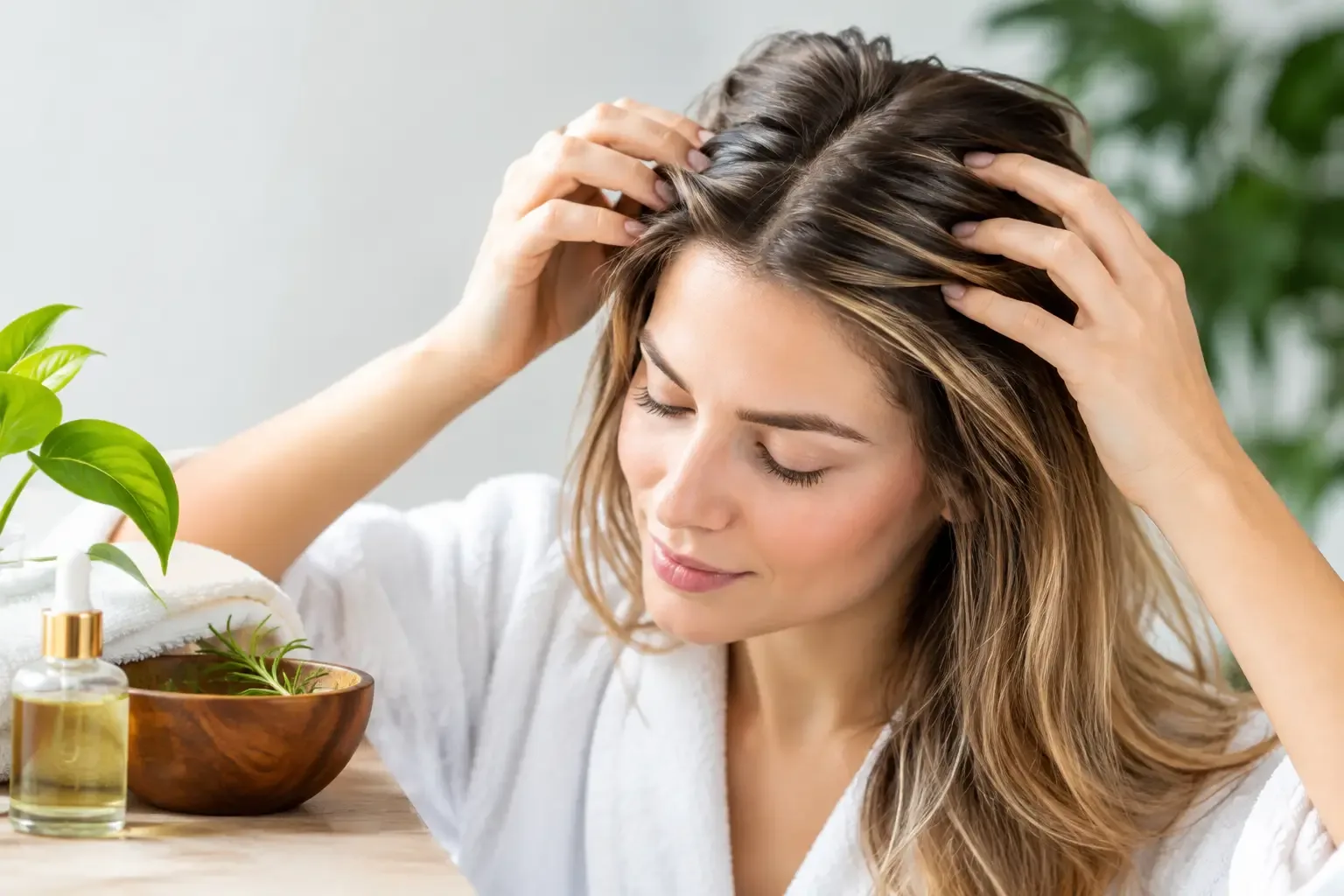
Use the pads of your fingertips, not your nails. Massage with light pressure for roughly a minute, focusing on the scalp rather than piling shampoo through the lengths. This helps lift buildup without unnecessary friction. Rinse thoroughly, especially around the crown and nape, where residue can linger.
Clean hair does not need to feel stripped. If your scalp feels squeaky, tight, or itchy after every wash, the cleansing approach may be too aggressive for this stage.
Treat the scalp as skin
Postpartum shedding is often centered on the hair, but scalp skin still sets the conditions for every strand that emerges. A lightweight, scalp-directed treatment can be useful when it matches a clear need, such as dryness, visible flaking, excess oil, or sensitivity.
Avoid assuming that more treatment means better care. Strong acids, abrasive scrubs, or dense oils may be appropriate for some people and unhelpful for others. If you introduce a new active treatment, do so one at a time and use it consistently enough to observe how your scalp responds. A patch test is sensible, particularly if your skin has become more sensitive after pregnancy.
If you are breastfeeding, pregnant again, taking medication, or managing a skin condition, check with your clinician before using medicated or concentrated treatments. Personalized guidance matters more than an ingredient trend.
For those interested in incorporating postpartum product into their scalp-care routine, explore Femme Regain Booster, developed with a scalp-first approach to hair longevity.
Protect the new growth you already have
Regrowth can appear as short, fine hairs around the hairline and part. These strands are not a styling problem to solve. They are evidence of renewal, and they benefit from low-tension handling.
Choose looser styles where possible. Rotate the placement of ponytails or buns. Use fabric-covered ties rather than tight elastics, and avoid repeatedly pulling the same area of the hairline. Detangle patiently, beginning at the ends and moving upward. When hair is wet and more elastic, support it rather than pulling through resistance.
Heat styling is not forbidden. The trade-off is cumulative stress, especially when your density feels temporarily reduced. Lower temperatures, fewer passes, and a heat protectant are more realistic than an all-or-nothing approach.
Build a routine that fits recovery
A well-designed postpartum routine is short enough to survive a difficult week. It might be a gentle cleanse when your scalp needs it, a targeted leave-on treatment a few times weekly, and calm handling every day. Consistency comes from reducing friction, not adding steps.
A practical rhythm can look like this: cleanse when buildup is present, apply a scalp treatment on a clean or nearly clean scalp as directed, and use a lightweight conditioner through mid-lengths and ends if they feel dry. Keep rich masks and oils away from the scalp unless they have a specific purpose for your skin condition.
The right frequency depends on your starting point. A person with an oily scalp in Singapore's humidity may feel best washing more often than someone experiencing dry, tight skin in air-conditioned environments. Neither approach is inherently better. The scalp's feedback is the data.
Track patterns, not single wash days
Postpartum recovery is variable. One week of shedding does not tell you whether a routine is working, and one good wash day does not mean a concern has disappeared. Look for patterns over several weeks: how much shedding you see, whether your scalp feels calmer, whether flaking changes, and whether the part appears stable or progressively wider.
Simple photos taken in the same lighting and part placement can be more useful than trying to judge density from memory. They create a clearer record of change without turning every glance in the mirror into a verdict.
This is where scalp analysis can add value. A close look at oil distribution, buildup, sensitivity, and follicular visibility can distinguish a scalp that needs gentler cleansing from one that needs more consistent cleansing or targeted support. HAAR approaches this as an adaptive process: assess the current condition, then adjust the protocol as the biology changes.
What not to do when shedding begins
The urge to act quickly is understandable. But some common responses create more stress than benefit.
- Do not stop washing your hair because you are afraid of what you will see in the drain. Hairs ready to shed will shed; delaying cleansing can leave oil and buildup on the scalp.
- Do not use tight styles to hide thinning at the temples or part. Repeated tension can add breakage and strain to an already vulnerable area.
- Do not cycle through multiple new serums, oils, and supplements at once. You will not know what is helping, what is irritating, or what is unnecessary.
- Do not equate shedding with permanent hair loss. Postpartum shedding is often temporary, though persistent or severe changes deserve professional assessment.
When to seek medical advice
Postpartum shedding commonly improves as the body settles, but timing and severity vary. Speak with a dermatologist or health care professional if shedding is extreme, continues well beyond the first postpartum year, develops in distinct patches, or comes with scalp pain, marked redness, scaling, or burning.
It is also worth asking about factors that can affect hair cycling, including iron status, thyroid function, nutritional intake, medication changes, and significant illness. Hair changes can be visible first, but they are not always scalp-only concerns.
Give your scalp time, then give it precision
The postpartum period does not call for panic buying or a punishing routine. It calls for a calmer standard: keep the scalp clean without stripping it, treat a defined concern rather than every possible concern, and reduce tension where new growth is emerging.
Your scalp is adjusting to a changed internal environment. Let the routine adjust with it. Small, precise care repeated over time is more valuable than a dramatic intervention at the first sign of shedding.